Threat Sharing
Understand why sharing email threat intelligence with peers cuts response time, and how to answer confidentiality concerns.
Archive edition. Data from 2020. Kept for reference. See the latest
What the data shows
- $1.7 billionin 2019 losses came from business email compromise complaints, according to the FBI IC3.See page 4
- 13 billionmalicious and suspicious emails were blocked in 2019, according to Microsoft.Page 5, in the full whitepaper
- 121 millionransomware attacks were recorded in the first half of 2020, according to ITPro.Page 5, in the full whitepaper
- 47%of IT Ops professionals said coordinating incident response across siloed teams is their biggest challenge (IDG, 2020).Page 6, in the full whitepaper
- Over 60%of attacks cited financial gain as the motive, according to the Verizon 2020 Data Breach Investigations Report.Page 6, in the full whitepaper
Start reading
- 1 / 14
- 2 / 14
- 3 / 14
- 4 / 14
Read the other 10 pages
They open right here. You can also download the PDF.
Tap a page to read it full size.
What the whitepaper covers
- Executive summary
- Evolution of cyber threats
- Shift from security to resilience
- Proactive and reactive
- Types of threat sharing
- Threat sharing platform: best practice
- Threat sharing and incident response
- Confidentiality concerns explained by game theory
Who it is for
SOC leads and CISOs who want peer threat intelligence to speed up email incident investigation without exposing confidential data.
Sources
This whitepaper draws on published third-party sources, cited inside the document.
Cite this whitepaper
Keepnet (2020). Threat Sharing. https://keepnetlabs.com/whitepapers/threat-sharing
Figures on this page may be quoted with this citation.
Threat Sharing
Share and receive phishing intelligence with trusted peers.
About this whitepaper
It is the exchange of threat data between organisations. One organisation's discovery becomes another's prevention, which reduces duplicated effort.
The whitepaper lists four: strategic, operational, tactical and technical. They range from board-level trend insight to technical feeds such as malicious IP addresses.
Many want to protect commercial interests and intellectual property, or fear that confidential data could be used against them. The whitepaper uses game theory to argue that shared intelligence lowers the combined loss.
Sharing alone is reactive. Linking shared indicators to incident response lets teams start investigations quickly, search their own inboxes and create rules to block further attacks.
Keep reading
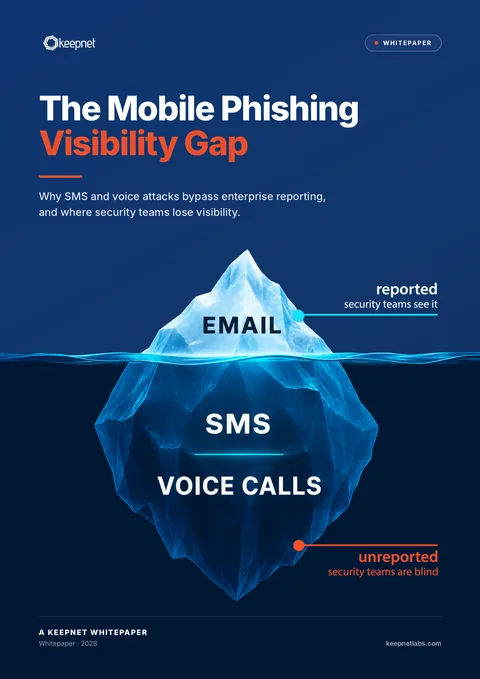
The Mobile Phishing Visibility Gap
~40%higher click rate on phone-based simulations than on email (Verizon DBIR 2026).Read the key findings
Cut Human-Driven Incidents: A CISO Playbook for Measurable Behaviour Change
76% vs 60%Most large firms train employees, yet human factors still sit behind most breaches.Read the key findings
2025 New Hires Phishing Susceptibility Report
44%more susceptible to phishing: new hires in their first 90 days compared with tenured employeesRead the key findings
2024 Voice Phishing (Vishing) Response Report
6.5%of 3,279 employees called shared sensitive information during simulated vishing calls.Read the key findings
The State of the Smish Report 2023
74%of organisations experienced a smishing attack in 2021, according to Safety Detectives.Read the key findings
2021 Email Security Vulnerability Report
90.56%of checked malicious test emails reached the target inbox past the security tools in place.Read the key findings
MSSP Business Model
$1.3 millionis the payroll an in-house team can reach once it staffs its own 24x7 SOC, according to Cipher.Read the key findings
2020 Phishing Trends Report
50.42%of simulated phishing emails were opened by the target in 2019.Read the key findings
See how Keepnet would act on these findings for you
- Run multi-channel simulationsFrom email through to deepfake.
- See reporting outcomes and the behaviour scoreReporting, repeat behaviour and remediation, in one board report.
- Explore AI agents and automationSee how simulations, training and follow-up can run with less manual work.

Book a 30-minute demo
Thirty minutes, no cost and no obligation.
Thank you, your request is in
A confirmation is on its way to your inbox.
Thirty minutes with the Keepnet team, on Microsoft Teams. Your details are already filled in.
Prefer to pick a time later? The team will follow up within one working day.
Your demo is booked
A calendar invite is on its way to your inbox, with a Microsoft Teams link.
The booking calendar will not open in this page.
Open the calendar in a new tab