What Is Human Risk Management in Cybersecurity? Definition & Benefits
Human risk management (HRM) is the analyst term for measuring and reducing the risk created by employee behavior. What it means, how it works, the metrics, and what Gartner calls it now.

On this page 15 sections
Human risk management (HRM) is a cybersecurity approach that measures, prioritizes and reduces the risk created by employee behavior: the clicks, approvals, shares and workarounds attackers rely on.
Forrester named the category in 2024. In 2026 Gartner started calling the same market secure behaviour management, because the goal is the behavior you want, not the risk you see in employees. The tools are largely the same. This page explains the HRM term and how it works. If you are choosing a platform, start with what is secure behaviour management.
The numbers show why the topic matters. The human element was involved in 62% of breaches (Verizon, 2026 DBIR, p. 12), yet 84% of security leaders still track training completion as a top program metric (Gartner, G00840741, n=65). Completion measures attendance. It does not measure behavior.
Human Risk Management definition
Human Risk Management (HRM) is the practice of detecting and measuring human security behaviors, quantifying behavior-driven cyber risk, and triggering targeted interventions (training, nudges, policy and process changes) to reduce that risk.
In other words: HRM is risk management for employee behavior, not a once-a-year training exercise.
Key takeaways
HRM becomes easy to understand when you remember these four rules.
- HRM is not “more awareness training”: HRM uses behavior signals + analytics to focus action where it matters most.
- HRM is continuous: It measures behavior over time and closes the loop with interventions and outcomes.
- HRM is role-based: Finance, HR, IT help desk, executives, customer support, each faces different attack patterns.
- HRM is outcome-driven: It proves impact with metrics leadership actually trusts.
Why Human Risk Management matters now
The “human element” is not a soft topic anymore. It’s a hard statistic.
Verizon’s 2026 DBIR notes that the human element was involved in 62% of breaches, up from 60% the year before (p. 12).
That’s why organizations are moving beyond generic education toward measurable behavior change.
The attacks are also getting more convincing. 41% of organizations were hit by a deepfake combined with social engineering on an audio call to an employee, and 35% on a video call (Gartner, G00847786, May 2026, n=297).
HRM exists for one practical reason:
Your biggest exposure is often the moment a person decides. HRM helps you influence that moment, using data.
Human Risk Management vs. Human Resource Management (HRM)
Yes, the acronym is confusing.
Human Resource Management = HR discipline (hiring, payroll, performance).
Human Risk Management (in cybersecurity) = reducing cyber risk created by human behavior using measurement + targeted interventions.
This page is about the second one.
Human Risk Management vs. Security Awareness Training
Security awareness training is usually one part of an HRM program, not the whole thing. Training builds knowledge and is measured by completion. HRM looks at what employees actually do, who repeats risky behavior, and whether that goes down over time.
We cover this comparison in depth, with a side-by-side table, in what is secure behaviour management.
Human Risk Management vs. Insider Risk Management
Insider Risk programs typically focus on data access misuse, malicious insiders, leakage, and policy enforcement.
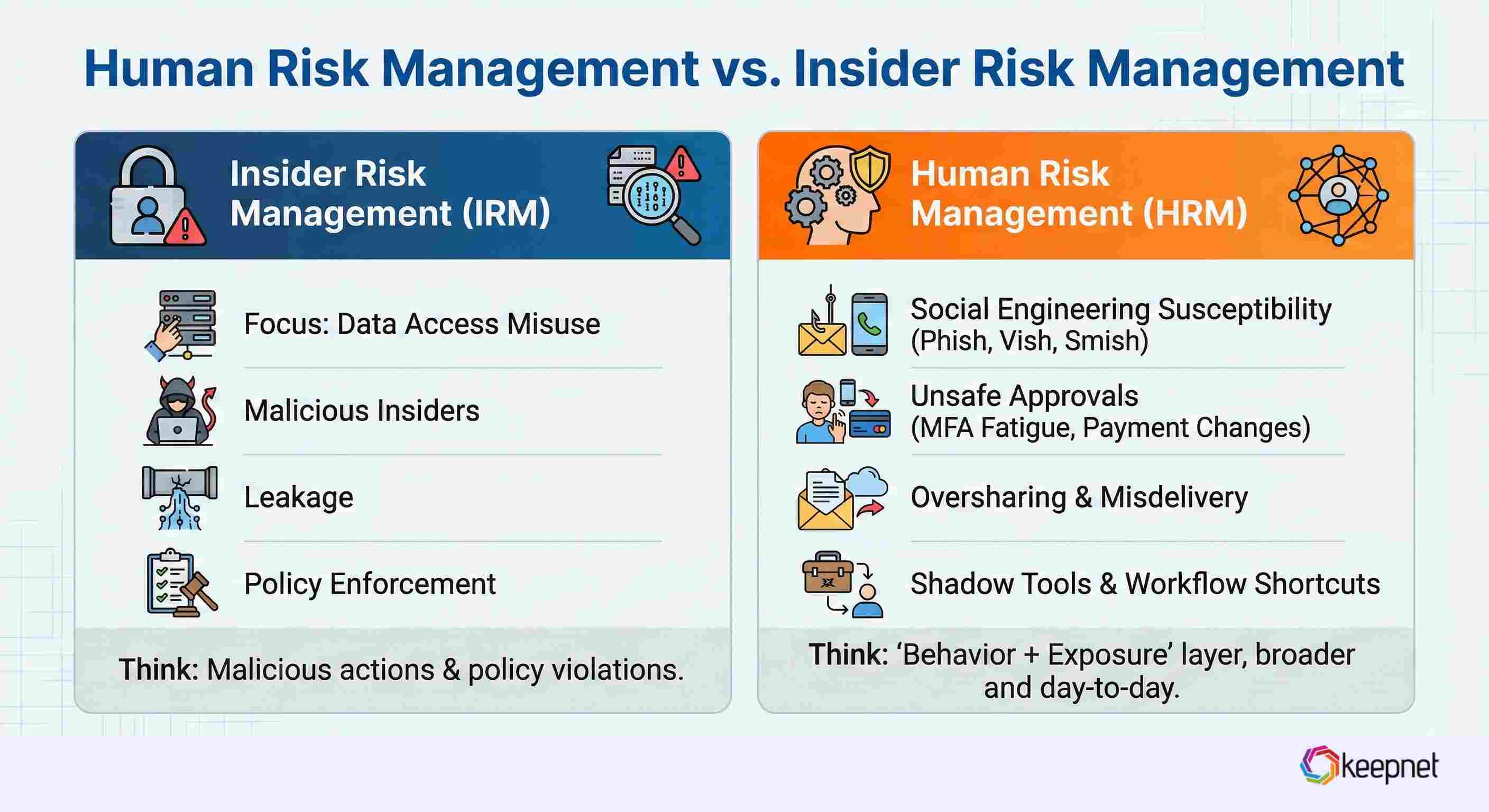
Human Risk Management is broader and more “day-to-day”:
- social engineering susceptibility (phish, vish, smish)
- unsafe approvals (MFA fatigue, payment changes)
- oversharing and misdelivery
- shadow tools and workflow shortcuts
Think of HRM as the “behavior + exposure” layer that complements your technical controls.
HRM, SBCP and secure behaviour management
Three names describe the same direction of travel:
- Security behavior and culture program (SBCP): Gartner’s term from 2022 for the program you run: executive sponsorship, behavior targets, culture. See what is an SBCP.
- Human risk management (HRM): Forrester’s term from 2024, framed around detecting and reducing risk.
- Secure behaviour management (SBM): Gartner’s market name from 2026 for the platforms behind these programs. See what is secure behaviour management.
In short: SBCP is the program, SBM is the platform market, and HRM is the risk-focused name many teams still use.
Keepnet platform
See which behaviours drive your risk
Keepnet measures behaviour before and after each simulation, nudge and training, by role and channel.
How Human Risk Management works
A good HRM program is simple, repeatable, and measurable. It usually follows a closed loop:
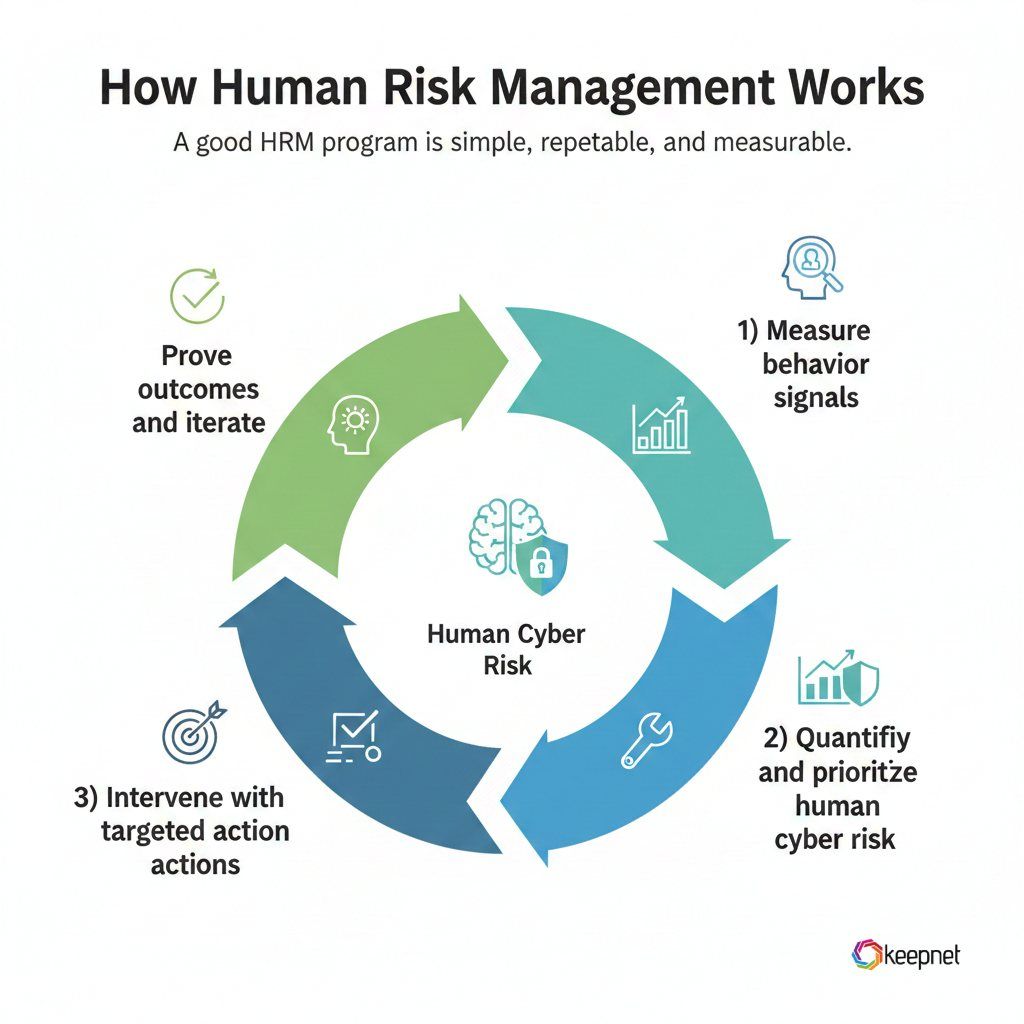
1) Measure behavior signals
You collect signals like simulation outcomes, reporting patterns, repeat behaviors, risky actions by workflow, and role-based exposure. This is where HRM moves from opinions (“employees are the problem”) to evidence (“these three workflows are creating repeated risk”).
2) Quantify and prioritize behavior-driven cyber risk
You translate signals into a practical risk view: risk by user, team, role, region, or job function. This helps you avoid wasting time on low-risk groups while high-risk workflows stay unchanged.
3) Intervene with targeted actions
Interventions should match the risk pattern, not your content calendar:
- microlearning for a role and scenario
- just-in-time training & nudges after risky behavior
- multi channel phishing simulations that mirror current attacker tactics
- process improvements that reduce security friction
This “measure → intervene” logic matches Forrester’s HRM framing.
4) Prove outcomes and iterate
You track whether risk trends move in the right direction, and whether the intervention reduced repeated risk. The goal is not perfection. It’s a measurable downward trend.
Benefits of Human Risk Management (what leaders care about)
HRM pays off when it creates outcomes you can show to the board, auditors, and operational teams.
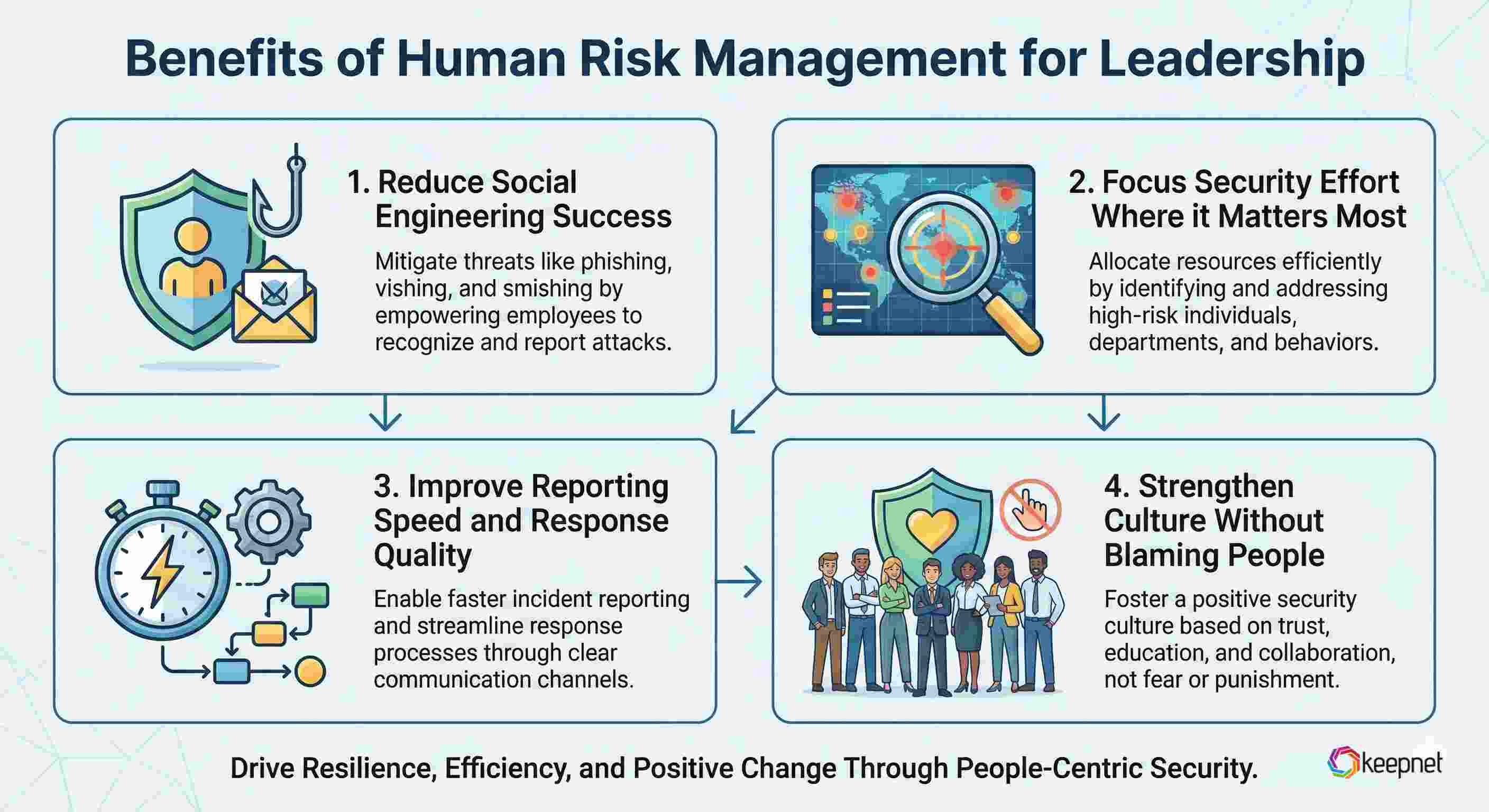
Reduce social engineering success
HRM helps reduce successful phishing, smishing, vishing, and deepfake-driven fraud attempts by targeting the roles and behaviors attackers actually exploit.
Focus security effort where it matters most
Instead of treating all employees as equal risk, HRM prioritizes based on real exposure and observed behavior, so your team spends time where it reduces risk fastest.
Improve reporting speed and response quality
Better reporting behavior means faster containment. HRM trains “what to do next” and reinforces it through nudges and repeated practice.
Strengthen culture without blaming employees
HRM isn’t about “employees are the problem.” It’s about making secure behavior the easiest behavior by reducing friction and improving workflows (a theme emphasized in Gartner’s PIPE framework for security behavior and culture programs).
Human Risk Management metrics (what to track)
HRM metrics work best when you group them into leading indicators (predict risk) and outcomes (prove results).
Leading indicators (behavior risk)
These help you act before incidents happen.
- Repeat-risk behaviors (same risky action repeating)
- Role exposure (e.g., Finance approvals, HR onboarding, IT help desk verification)
- MFA fatigue patterns (unsafe approvals under prompt pressure)
- QR and mobile susceptibility patterns (scan behavior)
- Vishing/callback verification discipline
Response indicators (security operations value)
These show how humans support detection and response.
- Time to report suspicious events
- Report quality (actionable details)
- Time to contain after a user report
Outcome indicators (business impact)
These prove HRM is working.
- Fewer successful social engineering incidents
- Fewer credential-related compromises
- Reduced preventable errors (misdelivery, oversharing, unsafe sharing settings)
To report these to a board, compare the same employees before and after. We explain how in how do you measure secure behaviour.
Human Risk Management examples: what HRM protects against
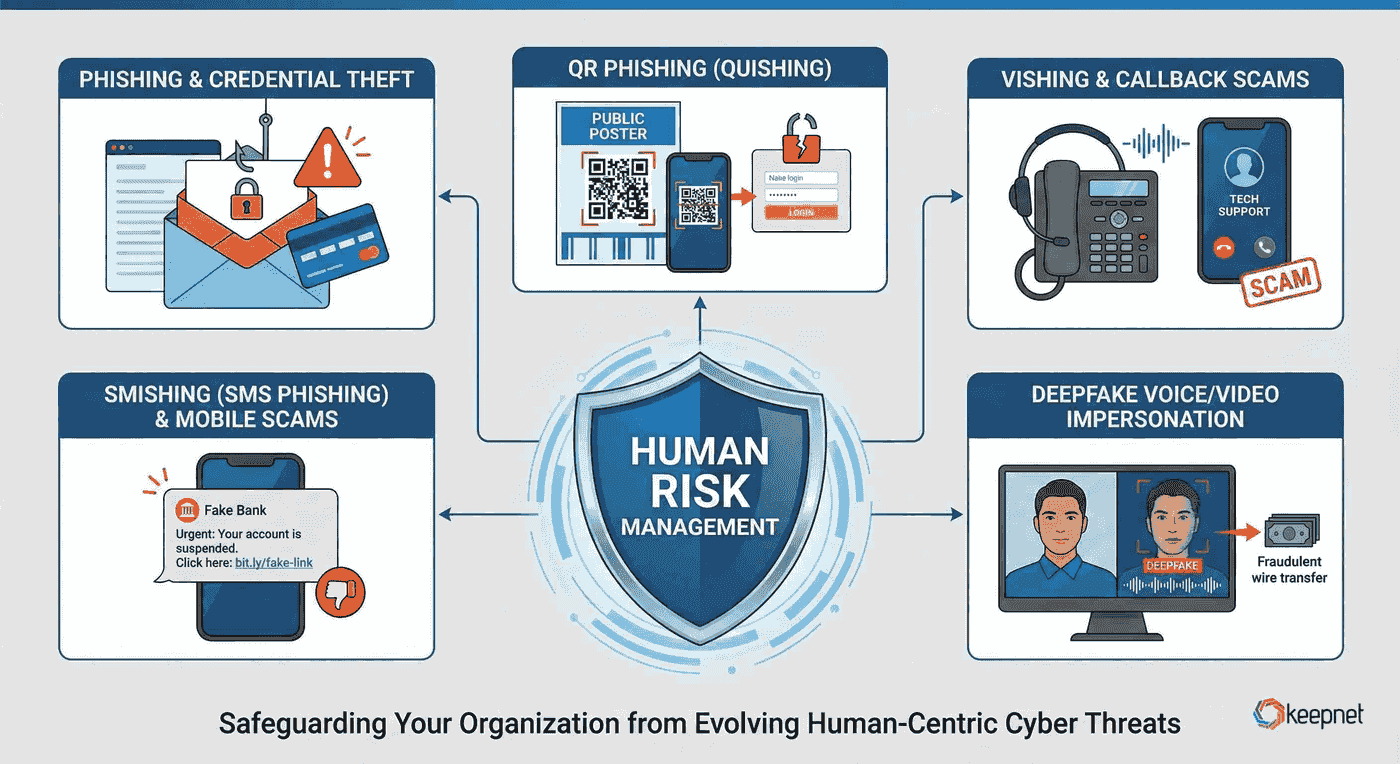
HRM is easiest to grasp through scenarios. Here are common HRM use cases.
Phishing and credential theft
Employees are tricked into entering credentials on lookalike pages. HRM reduces this by identifying who repeats risky behavior and delivering targeted coaching (not generic reminders).
Smishing (SMS phishing) and mobile scams
Mobile decisions are fast and distracted. HRM addresses mobile behavior with realistic smishing scenarios and just-in-time nudges.
QR phishing (quishing)
QR codes remove the “hover-to-check” safety moment. HRM helps by training QR-specific verification habits and testing QR decision-making in safe simulations.
Vishing and callback scams
Voice scams exploit urgency and helpfulness. HRM focuses on verification behaviors (what must be checked, what must never be shared) and reinforces them for high-exposure teams.
Deepfake voice/video impersonation
Deepfakes escalate “trust attacks.” Gartner puts deepfake social engineering on audio calls at 41% of organizations and on video calls at 35%. HRM reduces risk by training verification behaviors (out-of-band checks, secure approval processes) and by focusing on executive assistants, finance, help desk, and leadership, roles attackers target most.
Human Risk Management best practices
Programs that reduce human cyber risk tend to follow the same practices:
- Start with a baseline: run simulations across email, SMS, voice and QR codes before training, so you know where risk sits by department, role and channel.
- Train continuously, in short sessions: replace the annual course with short, role-based training triggered by what each employee actually does.
- Simulate the attacks employees really receive: include vishing, smishing, quishing, callback phishing and MFA fatigue, not only email.
- Make reporting easy and reward it: a one-click report button and quick feedback turn employees into an early warning system.
- Analyze reported threats quickly: triage reported emails, remove confirmed threats from every inbox and tell the reporter what happened.
- Set clear policies and verification steps: define how employees verify payment changes, password resets and urgent requests from executives.
- Measure outcomes, not completion: track click rates, reporting rates, time to report and repeated risky behavior, and share progress with leaders.
A practical 90-day Human Risk Management plan
A 90-day plan makes HRM real and helps you avoid “we’ll start next quarter” paralysis. Learn more: What Is An Example Of A Negative Cybersecurity Culture.
Days 1-30: Baseline + quick wins
Start with 2-3 high-impact scenarios (phishing-to-login theft, vishing/callback, MFA fatigue). Measure baseline behaviors, identify repeat-risk groups, and deploy short role-based microlearning and nudges.
Days 31-60: Role-based expansion
Expand to more roles and scenarios (smishing, QR phishing, deepfake impersonation). Build segments by role and exposure. Make reporting behavior part of the routine (what good reporting looks like).
Days 61-90: Automation + proof
Automate interventions where possible and show trend lines: repeat risk down, reporting speed up, fewer preventable incidents. This is where HRM earns trust and budget.
What a human risk management platform does
A human risk management platform, which Gartner now calls a secure behaviour management platform, usually covers five things:
- behavior measurement across employees, roles and channels
- segmentation by role, region and exposure
- targeted interventions: microlearning, nudges and simulations
- multi-channel simulations, not email-only
- reporting that shows behavior before and after
Gartner’s list of questions to ask a vendor, including AI control and deepfake safeguards, is in what is secure behaviour management.
Where Keepnet fits
Keepnet is an AI-native secure behaviour management platform. It covers multi-channel phishing simulations (email, voice, SMS, QR and callback), security awareness training, nudges by email, SMS and Teams, and Incident Responder for reported emails, SMS and calls. Behavior is measured before and after, by employee, department and channel.
Keepnet is listed in Table 1, Representative List of Secure Behavior Management Vendors, in Gartner, "Ditch Security Awareness and Adopt AI-Powered Secure Behavior Management", William Candrick, Alex Michaels, 22 September 2026. Keepnet is also listed among the example vendors for dynamic nudging and deepfake-based simulation training in Gartner, "Fight AI Disinformation: A CISO Playbook for Working with Your CIO, CCO and CMO", Akif Khan, 23 October 2025.
Gartner does not endorse any company, vendor, product or service depicted in its publications, and does not advise technology users to select only those vendors with the highest ratings or other designation. Gartner publications consist of the opinions of Gartner’s business and technology insights organization and should not be construed as statements of fact.
If you want to see which behaviors to work on first, book a demo and we will share a 90-day rollout plan.

Frequently asked questions
Human Risk Management is the practice of measuring human security behaviors, quantifying behavior-driven cyber risk, and triggering targeted interventions to reduce that risk.
They describe the same market. Human risk management frames the employee as a risk to reduce. Secure behaviour management, Gartner’s name since 2026, frames the goal as the behavior you want and measures it before and after.
No. Security awareness training builds knowledge and is measured by completion, while HRM measures and changes what employees actually do. The full comparison is in what is secure behaviour management.
Because the human element remains involved in a large share of breaches (62% in Verizon’s 2026 DBIR, p. 12).
Behavior measurement, human risk scoring, role-based segmentation, targeted interventions (training, nudges, simulations), and outcome reporting.
A human risk score is a practical rating assigned to a person, team, or role based on observed behaviors and exposure, used to prioritize interventions.
Ask to see the behaviors behind any score. A score you cannot explain is not a metric.
Repeat-risk reduction, time-to-report, report quality, role-based risk trends, and reductions in preventable incidents are usually the most useful.
Many teams can show measurable improvement within 30-90 days when they start with high-risk roles and targeted interventions.
HRM trains verification behaviors, such as out-of-band checks and secure approval steps, for the roles attackers target most. Gartner found 41% of organizations were hit by deepfake social engineering on an audio call and 35% on a video call (G00847786, n=297).
An HRM platform measures employee behavior, segments by role and exposure, runs targeted training, nudges and multi-channel simulations, and reports behavior before and after. Gartner now calls this a secure behaviour management platform; see what is secure behaviour management.
Set a baseline with multi-channel simulations, deliver short role-based training, simulate the attacks employees really receive, make reporting easy, analyze reported threats quickly, define verification steps for risky requests and measure behavior outcomes rather than course completion.
Find out which employees and behaviors carry the most risk, then act on them: targeted training for employees who click, verification steps for high-risk requests, phishing-resistant MFA and fast handling of reported threats. Repeat the measurement to confirm risk is going down.
Schedule your 30-minute demo now
You'll learn how to:
- See which behaviors create the most risk in your organization
- Plan training, nudges and simulations by role and channel
- Measure behavior before and after
30 minutes with a Keepnet specialist, on your own use cases.

Author
Ozan Ucar
Founder and CEO, Keepnet
Ozan founded Keepnet in 2017 and has worked in cyber security since 2006. He leads Keepnet's product direction and works with security teams on measuring and changing the behaviours behind incidents.