Top Cybersecurity Trends for 2026: AI Threats, Quantum Risks, and Zero-Trust
Learn about the top cybersecurity trends for 2026, from AI-driven threats to quantum computing challenges. Discover actionable strategies to secure your organization.

On this page 8 sections
Cybersecurity Ventures estimates global cybercrime costs will reach $10.5 trillion annually by 2025. This escalating threat highlights the need for organizations to stay ahead of increasingly sophisticated attacks. Cybercriminals are using AI-driven phishing, preparing for the disruptive potential of quantum computing, and exploiting gaps in outdated security frameworks.
In this blog, we’ll explore the top cybersecurity trends for 2025, the risks they pose to your organization, and actionable strategies to defend against them.
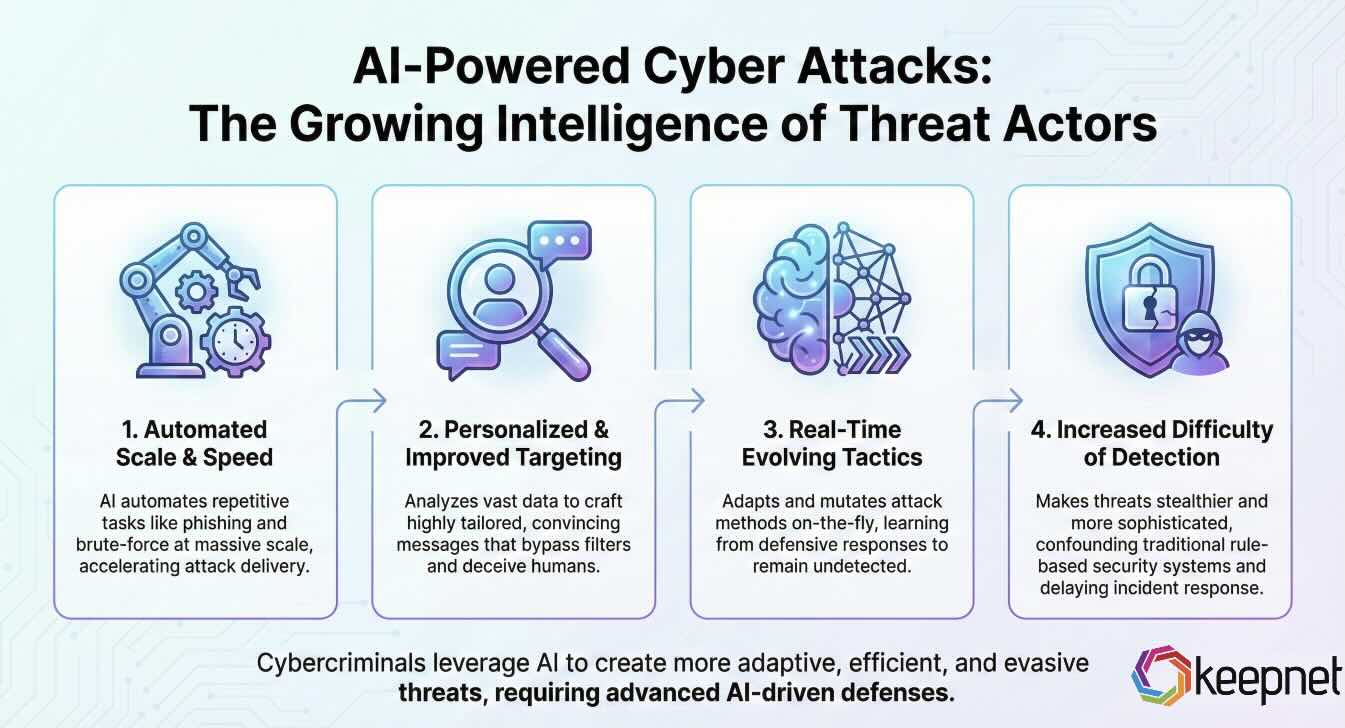
1. AI-Powered Cyber Attacks: The Growing Intelligence of Threat Actors
AI is no longer limited to helping defenders. Cybercriminals are leveraging AI based cyber attacks to automate and improve their attacks, making them more difficult to detect and defend against. AI can rapidly analyze data, personalize attacks, and evolve tactics in real time.
Risks to Organizations
- Automated Phishing Campaigns: AI can craft thousands of convincing and personalized phishing emails in minutes.
- Deepfake Fraud: AI-generated videos and audio can impersonate executives, tricking employees into making unauthorized transfers.
- AI-Powered Exploits: AI tools can scan for and exploit vulnerabilities faster than traditional methods, increasing the risk of data breaches.
Defense Strategy
To combat these threats, adopt AI-driven threat detection and regularly test employee awareness with phishing simulations using tools like Phishing Simulator. Keeping your employees vigilant is key to stopping AI-enhanced attacks.
2. Quantum Computing: The Looming Threat to Encryption
Quantum computing is on the horizon, offering the potential to solve problems far beyond the reach of traditional computers. However, it also threatens to undermine the very foundation of data security by breaking widely used encryption methods.
Risks to Organizations
- Future Data Breaches: Sensitive data encrypted today may be decrypted by quantum computers in the future, exposing financial records, intellectual property, and personal information.
- Encryption Obsolescence: Current cryptographic algorithms like RSA and ECC could become ineffective, leaving data unprotected.
Defense Strategy
Organizations must start preparing now by adopting quantum-resistant encryption. Implementing multi-factor authentication (MFA) and ensuring employees understand the importance of data protection through regular security awareness training is essential.
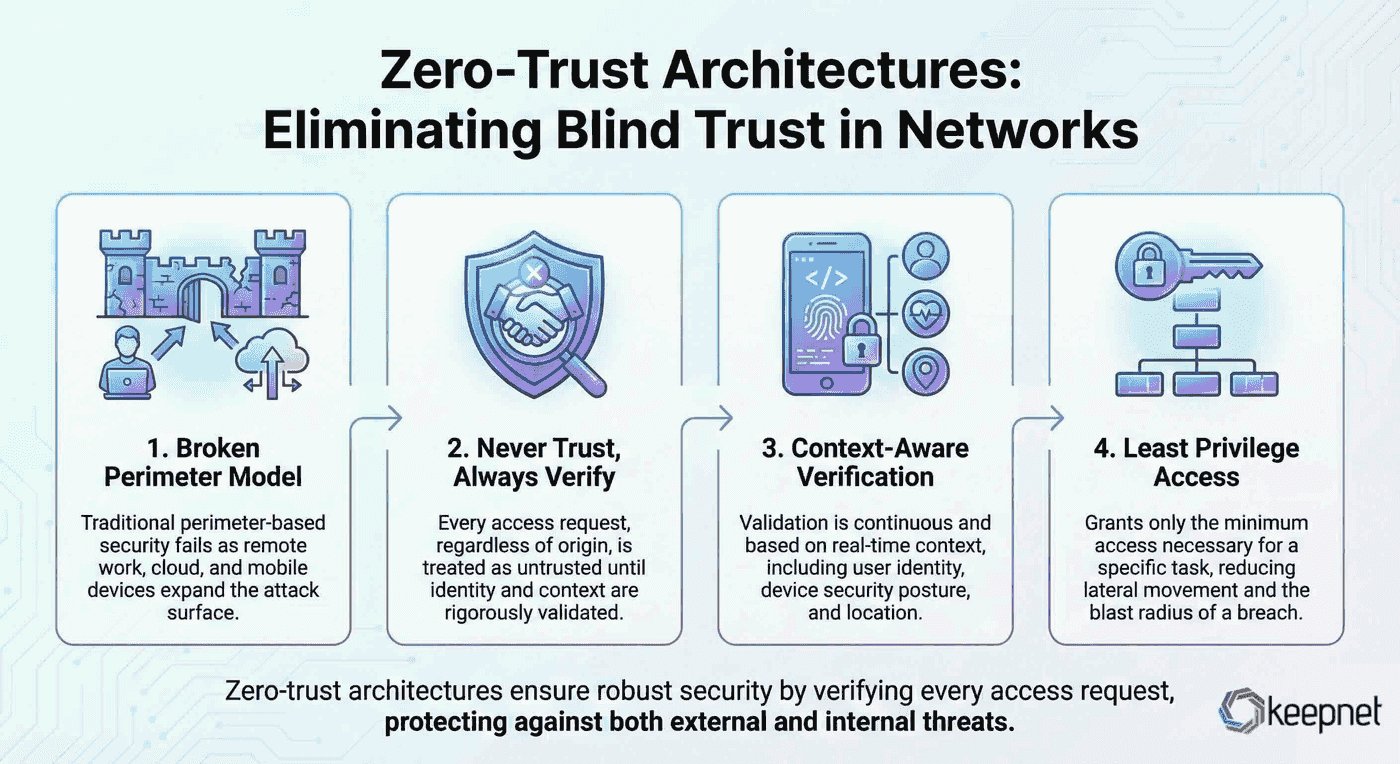
3. Zero-Trust Architectures: Eliminating Blind Trust in Networks
As remote work, cloud services, and mobile devices expand the corporate attack surface, traditional perimeter-based security is no longer effective. Zero-trust architectures ensure that every access request is verified, regardless of where it originates.
Risks to Organizations
- Lateral Movement: Once attackers breach a network, they can move laterally if proper controls aren't in place.
- Insider Threats: Employees with excessive access privileges can inadvertently or maliciously compromise sensitive data.
- Remote Work Vulnerabilities: Distributed workforces increase the risk of unauthorized access.
Defense Strategy
Implement a zero-trust framework that includes continuous authentication, least-privilege access, and network micro-segmentation. Reinforce these measures with security awareness training tool.
Keepnet platform
Turn awareness into secure behaviour
Training, multi-channel phishing simulations and reporting in one platform, measured by behaviour.
4. Deepfakes and Social Engineering: The New Face of Deception
Deepfake technology is becoming more accessible and sophisticated, making social engineering attacks harder to detect. These realistic deepfakes are being used to manipulate employees and bypass traditional security checks.
Risks to Organizations
- Fraudulent Transactions: Employees tricked by deepfake audio or video may transfer funds to malicious actors.
- Data Breaches: Attackers using synthetic identities can gain unauthorized access to sensitive systems.
- Reputation Damage: Successful deepfake attacks can erode trust in leadership and organizational security.
Defense Strategy
Conduct deepfake simulations to train employees to recognize voice-based scams. Implement multi-channel verification for high-stakes requests to confirm authenticity.

5. Human Risk Management: Reducing the Weakest Link in Cybersecurity
Despite advanced security technologies, human error remains one of the leading causes of data breaches. 68% of data breaches involve human factors (Ventures DBIR 2024).
Risks to Organizations
- Phishing and Social Engineering: Employees who lack awareness can fall for deceptive emails or phone calls.
- Weak Passwords and Poor Practices: Simple passwords and bad habits create vulnerabilities.
- Failure to Recognize Threats: Lack of training leaves employees unable to spot evolving cyber threats.
Defense Strategy
Adopt a comprehensive approach to human risk management. Use continuous security awareness training and phishing simulations to reinforce good security habits. Leverage tools like Keepnet's platform for human risk management and secure behaviour management to identify, monitor, and mitigate human-related vulnerabilities.
How Keepnet Aligns with 2026 Cybersecurity Trends
As cyber threats evolve, human risk management is essential for defending against AI-powered attacks, quantum risks, and social engineering. Keepnet helps organizations tackle these trends by:
- AI-Driven Phishing Simulations: Train employees to recognize AI-enhanced phishing attacks and reduce susceptibility.
- Human Risk Scoring: Identify and measure employees' vulnerabilities to pinpoint areas for improvement.
- Agentic Awareness Training: Offer customized, ongoing training to combat deepfakes, social engineering, and other emerging threats.
By leveraging Keepnet’s platform, you can build a resilient human firewall that stays ahead of evolving cybersecurity risks.

What This Means for Teams in 2026
Top Cybersecurity Trends for : AI Threats, Quantum Risks, and Zero-Trust is most useful when it helps teams make better day-to-day decisions. The strongest content does more than explain a concept. It shows where risk appears in real work, which actions matter first, and how teams can reduce confusion when the pressure is high.
That is why practical structure matters. A short explanation, a clear response path, and a few repeatable habits usually create more value than broad advice that looks complete but is hard to use.
Keepnet teams usually see stronger results when content like this is tied to a clear workflow, owner, and reporting path. A common mistake is treating top cybersecurity trends for : ai threats, quantum risks, and zero-trust as background knowledge instead of a decision that shows up in real operations.
Keepnet Recommendation
- Translate the concept into a small set of practical decisions users can apply quickly.
- Focus on the workflows where the issue creates the most business exposure.
- Add reporting and escalation guidance so people know what to do under pressure.
- Review the content regularly so examples and priorities stay current.
Frequently asked questions
AI is set to become a double-edged sword in cybersecurity for 2026. On the offensive side, threat actors will leverage AI to escalate the speed, scope, and effectiveness of attacks, including autonomous AI-driven assaults that move from experimental to fully operational. Defenders, however, will harness AI agents to enhance security operations, such as through "Agentic SOCs" for faster threat detection and response. This AI arms race will require organizations to implement governance and guardrails to manage risks like data poisoning and shadow agents.
Quantum computing poses a significant threat to traditional encryption methods, prompting a push toward post-quantum readiness. Organizations will prioritize quantum-safe cryptography to protect against future decryption attacks by quantum computers. This trend includes adopting quantum-resistant algorithms and preparing for "harvest now, decrypt later" scenarios where encrypted data is stolen today for future exploitation. Experts predict that quantum security will become a strategic imperative for safeguarding sensitive information across industries.
Zero-trust architectures will be a cornerstone of cybersecurity, assuming no implicit trust and verifying every access request. This model will expand to include cyber-hardened devices, edge AI, and continuous validation of users and machines. With the rise of remote work and IoT, zero-trust will help mitigate risks from insider threats and supply chain vulnerabilities by enforcing strict identity-based controls. Adoption will be driven by regulatory pressures and the need for resilience against sophisticated breaches.
Cybersecurity regulations will intensify, with shifts in disclosure requirements and enforcement of standards like PCI DSS v4.0 and CMMC. Organizations will face stricter timelines for reporting incidents, increased liability for executives, and mandates for transparency in cyber practices. This trend will also emphasize digital sovereignty, where governments push for localized data control to enhance national security.
Ransomware will shift from simple encryption to operational paralysis, targeting critical infrastructure and using AI for more targeted, multi-extortion tactics. Attackers will industrialize operations, focusing on data exfiltration and supply chain disruptions rather than just locking files. Defenses will prioritize resilience through backups, rapid recovery, and cyber insurance reforms that demand proven security postures.
Identity will become the primary line of defense, with a focus on managing human and machine identities amid explosive growth in non-human access points. Trends include unified identity platforms for seamless access management and combating risks like credential stuffing and insider threats. Geopolitical factors will amplify identity risks, as state actors target trust relationships in digital ecosystems.
Cloud-native architectures and continuous monitoring will become standard, driven by widespread migration to hybrid and multi-cloud environments. Security strategies will emphasize real-time threat detection, automated compliance, and protection against virtualization layer attacks. This shift addresses growing blind spots in cloud infrastructure, ensuring scalability and resilience against distributed threats.
Geopolitical fragmentation will redraw cyber battlefields, with increased state-sponsored attacks on critical infrastructure and private sectors. Widening cyber inequity between nations and organizations will exacerbate risks, as less-resourced entities face disproportionate threats. This trend will push for international collaboration and policies to counter espionage, sabotage, and hybrid warfare tactics.
Enterprises will shift from prevention-only approaches to building resilience, accepting that breaches are inevitable and focusing on rapid recovery. This includes investing in backup systems, incident response plans, and AI tools to minimize downtime from attacks. Resilience will be measured by trust metrics, with organizations prioritizing governance to maintain operations amid escalating threats.
Supply chain attacks will intensify, with attackers exploiting dependencies in software, vendors, and OT systems. Trends include enhanced scrutiny of third-party software, convergence of SSE and identity security, and regulations mandating vendor risk assessments. Organizations will adopt tools for monitoring machine identities and XoT (everything on the network) to secure interconnected ecosystems.
Schedule your 30-minute demo now
You'll learn how to:
- Develop comprehensive anti-phishing strategies to defend against AI-driven attacks.
- Customize training modules to fit your organization’s specific needs.
- Benchmark your team’s performance to identify and reduce human risk effectively.
30 minutes with a Keepnet specialist, on your own use cases.

Author
Ozan Ucar
Founder and CEO, Keepnet
Ozan founded Keepnet in 2017 and has worked in cyber security since 2006. He leads Keepnet's product direction and works with security teams on measuring and changing the behaviours behind incidents.