Cybersecurity Awareness Month 2026: Theme, Ideas, and a Four-Week Plan
Plan Cybersecurity Awareness Month 2026 with the official theme, a four-week schedule, and activities that change behaviour instead of measuring completion.

On this page 14 sections
Cybersecurity Awareness Month 2026, often shortened to Cyber Security Month, runs throughout October, and for most organisations it is the one month of the year when security has the attention of the whole company. That attention is worth more than a poster campaign.
The theme for 2026 is Don’t Make It Easy for Them, published by the National Cybersecurity Alliance. The message is simple: this October, make life difficult for cybercriminals by fixing the everyday habits attackers rely on.
This guide covers the 2026 theme, what has changed in the threat landscape this year, a four-week plan you can run from 1 October to 31 October, and the activities and metrics that show whether the month actually worked.
Editor’s Note: This article was updated on August 6, 2026.
Resource
Free Deepfake Phishing Simulation
Celebrate Cybersecurity Awareness Month with a one-time, zero-cost deepfake simulation
What is Cybersecurity Awareness Month?
Cybersecurity Awareness Month 2026 is a global initiative held every October to remind individuals and organisations that protecting our digital world is everyone’s responsibility. Co-led by the National Cybersecurity Alliance and CISA, this campaign focuses on promoting safer online behaviour across all industries and communities. You will also see it called Cyber Awareness Month or simply Cybersecurity Month; all three names refer to the same October campaign.
Since its launch in 2004, the programme has inspired millions to take simple, effective steps toward better online safety, whether that means creating stronger passwords, enabling multifactor authentication, or staying alert to phishing attempts.
Throughout the month, businesses, schools, and government institutions organise cybersecurity awareness activities, training programmes, and phishing simulations to build a strong security culture from the inside out. The message behind this year’s theme, “Don’t Make It Easy for Them,” is clear: small actions can make a big impact in protecting both personal and organisational data.
Participating in Cybersecurity Awareness Month 2026 isn’t just a symbolic gesture, it’s a smart, strategic way to reduce human-related cyber risks and embed long-lasting security habits across your workforce.

Why October 2026 Matters for Cybersecurity
October 2026 is the one month of the year when security awareness has the attention of the whole organisation. That makes it the best window you will get to change behaviour, not just to repeat information.
Two numbers explain why the month still matters.
The human element appeared in 62% of breaches.[1]
Social engineering was the third most common breach pattern, present in 16% of breaches.[1]
Technical controls keep improving, and attackers keep going through people, because that route still works. A month of posters will not change that. A month of practice can.
Cybersecurity Awareness Month 2026 Theme: Don’t Make It Easy for Them
The theme for Cybersecurity Awareness Month 2026 is Don’t Make It Easy for Them, published by the National Cybersecurity Alliance. The supporting message is direct: this October, make life difficult for cybercriminals.

The theme is useful because it points at effort rather than fear. Attackers take the cheapest path available to them, and every habit below raises the cost of that path. The campaign promotes four core actions:
- Use strong passwords and a password manager
- Turn on multifactor authentication
- Update software regularly
- Recognise and report phishing attempts
These four actions are the backbone of the campaign every year, and they are still the fastest place to start. The sections below turn them into a schedule your team can actually run.
Your Four-Week Plan for Cybersecurity Awareness Month 2026
Most Cybersecurity Awareness Month pages hand you a list of ideas. A list is hard to run and easy to abandon by week three. Below is a four-week structure you can follow from 1 October to 31 October, with one focus per week and one number to measure.
Week 1: Reporting
Teach one action and make it one click. The goal of week one is not to catch people out, it is to make reporting the reflex when something looks wrong.
Run a straightforward email simulation, then publish the report rate, not the click rate. Report rate tells you whether people are helping your security team. Click rate only tells you who was busy that morning.
Week 2: Voice and SMS
Most programmes test email and stop there. That leaves the channel where people fail more often completely untested.
Median click rate in email simulations sits near 1.4%, while phone-centric simulations sit near 2%, roughly 40% higher failure on the phone.[2]
Run a vishing or smishing exercise this week. Brief the team afterwards on what a callback scam sounds like, because voice attacks are the ones people describe as convincing after the fact.
Week 3: Payments and Approvals
Aim this week at finance, accounts payable, and executive assistants. The scenarios that matter here are invoice fraud, bank detail change requests, and urgent approval requests that arrive out of hours.
Give this group a written rule they can fall back on: no payment detail change is actioned from email alone, ever, regardless of who appears to be asking.
Week 4: Measure and Publish
Close the month by showing what moved. Publish the change in report rate and the change in time to report. Name no individuals and no departments.
This is where most programmes go wrong, because they report the wrong thing.
84% of security leaders track training completion as a top programme metric.[3]
41% of employees say they bypassed cybersecurity guidance in the past 12 months, and 61% of them know it increases risk.[4]
Completion tells you people finished the module. It does not tell you they will behave differently on 3 November. Report rate, time to report, and repeat-failure rate do.
Cybersecurity Awareness Month Ideas and Activities for Employees
The ideas that work in October are the ones people finish in a few minutes and can repeat on 3 November. Each one below fits inside the four-week plan above.
- Spot the Phish contest. Share five real-looking emails, ask employees which ones they would report, and publish the answers the next day. Reward the team with the most correct reports, not the fewest clicks.
- Report-rate leaderboard. Rank departments by how many suspicious messages they report during the month. It turns the reporting button into the thing people compete over.
- Cyber Security Awareness Day on 1 October. Open the month with a short message from a leader outside IT, a five-minute live demo of how to report an email, and one rule for the whole month.
- Cyber Awareness Week in the last week of October. Send one tip a day in Teams or Slack, each tied to the habit of that week, and close with a short quiz.
- Security escape room. Build a 20-minute puzzle, online or in a meeting room, where each clue is a security decision: a payment change, an unexpected MFA prompt, a QR code on a poster.
- Trivia quiz with small prizes. Ten questions based on attacks your own team has seen, run live in a team meeting.
- Password and MFA clinic. Thirty minutes where employees bring their phone and leave with a password manager installed and MFA switched on.
- Callback and voice demo. Play a short recording of a callback scam and ask the room at which point they would have hung up.
Cybersecurity Awareness Month Tips to Share With Employees
- Report anything that asks for a password, a code or a payment, even if it looks internal.
- Confirm any change of bank details by calling a known number, never the one in the message.
- Deny an MFA prompt you did not start, then tell the security team.
- Check where a QR code leads before you enter anything on the page it opens.
- Lock your screen when you step away, even for a minute.
Security awareness training
Training that follows what each employee does
Short modules and nudges matched to behaviour, with compliance reporting built in.
What Is New in 2026: AI Voice, Deepfakes, and QR Attacks
In 2026 the attacks employees meet are no longer badly written. Attackers use AI to clone voices, generate video, and write phishing messages that read like internal email.
AI-automated phishing reached a 54% click-through rate compared with 12% for standard phishing.[5]
84% of security leaders observe more advanced phishing.[6]
35% of organisations have been affected by deepfake incidents, while only 10% of security leaders prioritise deepfake recognition and reporting in their awareness programmes.[7]
That gap between what employees are facing and what awareness programmes actually train for is the thing to close this October.
See the table below for the top cybersecurity trends driving this change.
| Trend | Description |
|---|---|
| AI-Powered Threats | Attackers now use AI to generate deepfake videos, mimic voices, and write convincing phishing emails, making deception faster and more scalable. |
| Social Engineering Surge | Sharp rise in phishing, vishing, smishing, and quishing, all designed to exploit user trust and bypass technical controls. |
| Human Risk Management | Greater emphasis on tracking and improving user decisions through risk scoring, behaviour analytics, and continuous assessments. |
| Simulation-Based Training | Increased deployment of Phishing, Smishing, and Quishing Simulators to mirror real attack scenarios. |
| Behaviour-Based Learning | Use of adaptive Security Awareness Training that adjusts content based on user responses and risk levels. |
| Data-Driven Defence | Use of human risk scores to prioritise training needs, benchmark awareness, and guide strategic investments in security programmes. |
| Deepfake-Driven Breaches | Increase in breaches involving deepfake audio/video impersonations, especially in CEO fraud, payment redirection scams, and internal manipulation. |
In 2026, defending your organisation means enabling employees to detect threats like AI-generated phishing and deepfakes through behaviour-focused training and real-time risk insights.
Learn how cybercriminals are applying Agentic AI to make social engineering attacks more effective in this detailed Keepnet article: How Hackers Use Agentic AI to Advance Social Engineering.
Top Actions You Can Take This October
As Cybersecurity Awareness Month 2026 unfolds, it’s the perfect time to take action against the fast-evolving threats of today’s digital world. With phishing, deepfakes, and AI-powered scams on the rise, it’s critical to strengthen access controls, test your response capabilities, and limit public exposure. These targeted steps help turn awareness into effective defence.
For posters, a one-page PDF and the official logo, see the toolkit section further down this page.
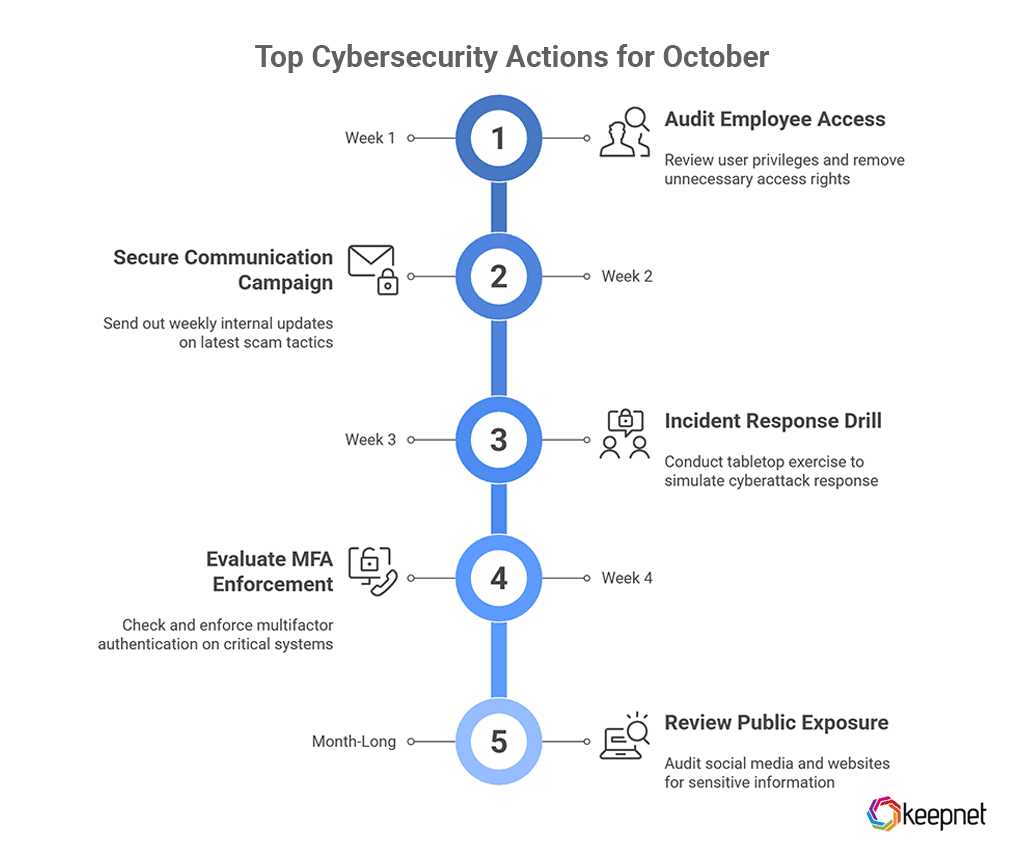
Audit Employee Access and Permissions
Restricting access to only what users need limits the damage a compromised account can cause. Review user privileges and remove outdated or unnecessary access rights. This is a quick win that reduces internal vulnerabilities.
Launch a Secure Communication Campaign
Send out weekly internal updates featuring the latest scam tactics and how to avoid them. Focus on emerging threats like deepfake impersonations, voice cloning, and quishing. Regular reminders help keep cybersecurity top-of-mind.
Conduct an Incident Response Drill
Tabletop exercises simulate a cyberattack and test your team's ability to react under pressure. These drills uncover communication gaps, improve decision-making, and validate whether your response plan works in real time. They’re essential for ensuring your team is prepared before a real crisis hits.
Evaluate MFA Enforcement
Check that multifactor authentication is not just available but mandatory on all critical systems. This adds a layer of protection, especially against credential theft and phishing attempts. Strong MFA policies reduce the risk of unauthorized access.
Review Public Exposure
Audit social media and company websites for personal or sensitive information that could be used in a targeted attack. Even small details, like job roles or executive travel plans, can aid phishing and impersonation scams. Regular cleanup reduces your attack surface.
Combining technical controls with human-focused strategies builds a strong cybersecurity culture where secure behaviour becomes part of everyday operations. This approach strengthens organisational resilience during Cybersecurity Awareness Month and beyond.
Cybersecurity Awareness Month Toolkit: Posters, a One-Page PDF and the Logo
Printed material works when it repeats the same few habits as the rest of the month.
A one-page PDF handout should fit on a single sheet and answer four questions: how to report a suspicious email, text or call; what to do when someone asks to change bank details; what to do with an MFA prompt you did not start; and who to contact if you clicked.
Posters belong where decisions happen: next to printers, in kitchens, by the reception desk. One habit per poster is enough.
The official campaign assets, including posters and social graphics, are published by the National Cybersecurity Alliance. Check its usage guidance before adding the campaign logo to internal emails, PDFs or video backgrounds.
How to Participate in Cybersecurity Awareness Month 2026
Get involved in Cybersecurity Awareness Month by organising focused, engaging initiatives that reflect the 2026 theme, “Don’t Make It Easy for Them.” These activities help raise awareness, drive secure behaviours, and strengthen your organisation’s cyber posture.
- Align with the Official Theme: Build your campaign around the 2026 theme, “Don’t Make It Easy for Them,” by emphasising four key behaviours: using strong passwords, enabling multifactor authentication, updating software, and recognising phishing. Integrate these into your communications, training sessions, and awareness materials.
- Register as a Cybersecurity Awareness Month Champion: Sign up through the National Cybersecurity Alliance to access official toolkits, posters, email templates, and campaign resources designed to support your internal initiatives.
- Host Interactive Sessions: Organise engaging events like webinars, lunch-and-learns, or team Q&As to discuss current threats and safe practices. Use real-world examples to keep sessions relevant and practical.
- Distribute Weekly Tips and Threat Spotlights: Share bite-sized content throughout October featuring recent phishing scams, password hygiene reminders, or deepfake awareness tips. Rotate content themes weekly to maintain engagement.
- Encourage Employee Involvement: Invite staff to share their own cybersecurity habits, participate in awareness challenges, or test their knowledge through quizzes and games.
- Use Awareness Hashtags: Promote your campaign on internal platforms or social media using hashtags like #SecureOurWorld, #CybersecurityAwarenessMonth, and #StayCyberAware to build visibility and participation.
These structured actions not only align with national efforts but also help embed cybersecurity into your workplace culture - making secure behaviour a shared and lasting priority.
Content and Communication Strategy for October
A strong communication strategy ensures that cybersecurity messages are seen, understood, and acted upon across the organisation. Use a structured approach to deliver clear, engaging content throughout October.
| Strategy Element | Description |
|---|---|
| Weekly Themes | Break content into weekly topics, such as phishing, strong passwords, software updates, and MFA, to keep messaging focused and easy to follow. |
| Multi-Channel Delivery | Use a mix of email, intranet, chat apps, digital displays, and posters to distribute content across teams and work environments. |
| Clear, Actionable Messaging | Keep content brief and specific. Use bullet points and plain language to outline what actions employees should take and why it matters. |
| Real-World Examples | Share relevant incidents such as phishing scams or deepfake frauds to illustrate risks and reinforce lessons through practical context. |
| Interactive Engagement | Encourage participation through quizzes, polls, or employee-submitted tips. Interaction boosts retention and fosters a stronger learning culture. |
| Performance Tracking | Monitor open rates, quiz completions, and feedback submissions to evaluate effectiveness and refine communication throughout the month. |
How Keepnet Supports the Cybersecurity Awareness Month Initiative
Keepnet's secure behaviour management platform helps organisations enhance their Cybersecurity Awareness Month campaigns with tools and training that build lasting behavioural change:
- AI-Powered Phishing Simulator: Create realistic phishing campaigns with 22,000+ templates and 20 customisation tags, designed to mimic current attack trends and train users in real time.
- Personalised Security Awareness Training: Deliver adaptive training based on employees’ risk levels and preparedness, aligning content with actual knowledge gaps.
- Security Awareness Training Marketplace: Access 11,000+ training materials from 12 content providers in 61 languages (as of 19 October 2026), making it easy to support diverse teams across departments and regions.
- Security Awareness Program Manager: Use AI to automatically design and manage tailored training plans throughout the month, keeping content relevant and engaging.
- Free Deepfake Phishing Simulation: free during Cybersecurity Awareness Month, see the free deepfake phishing simulation.
These tools help organisations turn Cybersecurity Awareness Month into measurable progress, building awareness, reducing human error, and reinforcing a security-focused culture.
Explore Keepnet’s Free Security Awareness Training to kickstart your campaign and empower your team.
How to Make the Month Useful
Security Awareness Month only helps if it changes behaviour after the campaign ends. The strongest programmes do not try to teach everything in four weeks. They pick a few habits, reinforce them across channels, and make managers part of the follow-through.
In practice, that means replacing generic celebration content with short, role-based actions. A month-long campaign can still create momentum, but it should leave behind reporting habits, stronger verification routines, and a clean list of behaviours to revisit in the next quarter.
Keepnet teams usually see the biggest gains when training is tied to a reporting path and a follow-up workflow. For most organisations, the common mistake is treating Cybersecurity Awareness Month as content delivery instead of behaviour design.
Campaign Design Checklist
- Choose one or two high-risk behaviours for the month instead of covering every topic.
- Use a mix of short simulations, reminders, and manager-led reinforcement.
- Track reporting quality, repeat-risk users, and follow-up actions after the campaign ends.
- Turn the best-performing assets into evergreen training, not one-off campaign material.
Sources
- Verizon 2026 Data Breach Investigations Report, p. 12. ↩
- Verizon 2026 Data Breach Investigations Report, p. 50. ↩
- Gartner, "6 Ways to Transform Your Cybersecurity Awareness Program" (G00840741, March 2026), 2025 Secure Behavior Strategies Survey (n=65). ↩
- Gartner, "Drive Secure Behavior With 4 Employee-Focused Tactics" (G00840742, February 2026), 2025 Secure Behavior: Employee Perspectives Survey (n=175). ↩
- Microsoft, Digital Defense Report 2025. Microsoft Incident Response and Defender dataset, not a global breach census. ↩
- Gartner, "Cybersecurity Trend: GenAI Breaks Traditional Cybersecurity Awareness Tactics" (G00840678, January 2026), 2025 Gartner Cybersecurity Innovations in AI Risk Management Survey (n=302). ↩
- Gartner, G00840678 (n=302) and Gartner, "6 Ways to Transform Your Cybersecurity Awareness Program" (G00840741, March 2026), 2025 Secure Behavior Strategies Survey (n=65). ↩
Frequently asked questions
Cybersecurity Awareness Month began in 2004 as a collaboration between the U.S. Department of Homeland Security and the National Cyber Security Alliance. Its purpose was to raise awareness about the importance of cybersecurity, and it has since grown into a global effort with participation from governments, businesses, and individuals.
Individuals can participate by implementing the core "Don’t Make It Easy for Them" actions: using strong, unique passwords with a password manager, enabling multi-factor authentication on all accounts, regularly updating software on all devices, and learning to spot and report phishing attempts. Following official campaigns on social media is also a great way to stay informed.
Cybersecurity should be part of a continuous culture, not a once-a-year initiative. Extend impact by integrating monthly awareness refreshers, ongoing phishing simulations, and quarterly tabletop exercises to keep knowledge and response skills current.
The official resources for the campaign are provided by the National Cybersecurity Alliance (NCA) and the Cybersecurity and Infrastructure Security Agency (CISA). Their websites offer toolkits, social media graphics, and guides to help companies and individuals align with the annual themes and promote cybersecurity best practices.
The activities that change behaviour are the ones people finish and can act on. Run phishing, vishing, and smishing simulations so employees meet the attack in a safe setting rather than in their inbox on a bad day. Use short gamified training instead of hour-long modules. Hold one live session with a guest speaker to break the routine. Run a quiz or a department competition to lift participation. Tie every activity back to the 2026 theme, Don’t Make It Easy for Them, so the month reads as one campaign instead of five unrelated events.
Keepnet offers a free AI-powered phishing simulation test that is highly effective for preparing your team against modern threats, including those that leverage advanced AI and deepfake technologies. You can use this free tool to launch a simulated attack on your employees, get a comprehensive report on your team's readiness, and access valuable security awareness training resources, all at no cost. This is an excellent way to evaluate your organisation's human risk score and begin building a more resilient security culture.
Engaging ideas for your campaign should focus on making security concepts fun and interactive. Consider activities like:
- Hosting a "Spot the Phish" competition with a leaderboard.
- Organising a cybersecurity-themed "escape room" puzzle.
- Running a trivia quiz with small prizes for top performers.
- Creating short, animated videos that simplify complex security topics.
- Hosting a "brown bag" lunch session to discuss real-world cyber threats.
- Using Keepnet's free deepfake phishing simulation.
You can officially participate by becoming a National Cybersecurity Awareness Month Champion. This is a free way for organisations to show their support and receive access to official campaign materials, resources, and weekly messaging to share with employees and stakeholders.
Yes, while the core messages are global, many countries and regions, including the UK, adopt specific campaigns and resources tailored to their local context. This allows them to focus on unique regional threats and regulatory requirements, ensuring the messaging is highly relevant and actionable for their audience.
CISA (Cybersecurity and Infrastructure Security Agency) is a federal partner that co-leads the Cybersecurity Awareness Month campaign in the U.S. with the National Cybersecurity Alliance. They provide a wealth of official resources, toolkits, and guidance for businesses and government entities to improve their cyber defences and educate their workforce.
The primary target audience is the general public and all employees within an organisation, not just the IT or security teams. The campaign is built on the understanding that human behaviour is a key factor in cybersecurity. Its goal is to provide everyone with the knowledge and tools to identify and mitigate online risks, making them a stronger line of defence.
You can measure success by tracking key metrics and employee behaviours. Look at the reduction in phishing click rates from your simulation tests, an increase in reported suspicious emails, or an increase in the number of employees who have enabled multi-factor authentication. You can also survey employees to gauge their confidence and knowledge about security best practices after the campaign.
The long-term impact extends beyond a single month of activities. Consistent participation helps embed a culture of security awareness and vigilance within your organisation. It leads to sustained behavioural changes, making employees more likely to apply security best practices throughout the year, which in turn reduces the likelihood of a successful cyberattack and strengthens your overall resilience.
Cybersecurity Awareness Month 2026 runs throughout October, from 1 October to 31 October. It has taken place every October since 2004, and in the United States it is co-led by the Cybersecurity and Infrastructure Security Agency and the National Cybersecurity Alliance. The purpose of the month is to move people from knowing about cyber risk to acting on it, which is why the strongest campaigns pair awareness content with real practice.
The theme for Cybersecurity Awareness Month 2026 is Don’t Make It Easy for Them, published by the National Cybersecurity Alliance. The campaign asks organisations and individuals to make life harder for cybercriminals through four everyday habits: strong unique passwords kept in a password manager, multifactor authentication, prompt software updates, and recognising and reporting phishing. Organisations that want to go further pair those habits with simulations, so employees practise the behaviour rather than only reading about it.
Pick one behaviour per week and measure it. A four-week structure holds attention better than a long list of activities: week one on reporting, week two on voice and SMS attacks, week three on payment and approval fraud, week four on publishing what improved. Add one short training and one live simulation to each week, ask a leader outside IT to send the opening message so the month does not read as an IT project, and use the official campaign assets from the National Cybersecurity Alliance for posters and social posts.
Schedule your 30-minute private demo now.
You'll learn how to:
- Launch role-based Security Awareness Training programs aligned with the Cybersecurity Awareness Month 2026 theme.
- Customize training modules to address your team’s specific risk levels and knowledge gaps.
- Track employee progress, measure human risk, and generate compliance-ready reports.
30 minutes with a Keepnet specialist, on your own use cases.

Author
Ozan Ucar
Founder and CEO, Keepnet
Ozan founded Keepnet in 2017 and has worked in cyber security since 2006. He leads Keepnet's product direction and works with security teams on measuring and changing the behaviours behind incidents.